Recovery from concussion is rarely a straight line.
Some people feel themselves again within a couple of weeks. For others, headaches linger, sleep becomes unreliable, concentration slips, and the world feels a little too bright or too loud for longer than expected.
If that's where you find yourself, the first thing worth saying is this: most people do recover, and that recovery can be supported.
A note before we begin
Concussion is a medical condition, and any head injury should be appropriately assessed by a doctor or other qualified healthcare professional. Nothing here is a substitute for that assessment, or for the guidance of your GP, concussion service, or the return-to-work, study, exercise or sport advice you've been given.
Acupuncture, when appropriate, works alongside that care — never instead of it.
When to seek urgent medical care
Most concussions settle with time and appropriate care. Occasionally, however, symptoms after a head injury can point to something more serious.
Seek urgent medical attention if you or someone you're caring for experiences:
- a headache that keeps getting worse
- repeated vomiting
- increasing confusion, drowsiness, or difficulty staying awake
- a seizure
- weakness, numbness, or problems with balance or coordination
- slurred speech or significant changes to vision
- clear fluid or bleeding from the nose or ears
These situations are uncommon, but they matter. When in doubt, get checked.
What happens in a concussion?
A concussion is a form of mild traumatic brain injury. It doesn't necessarily require a direct blow to the head — a sudden jolt or whiplash-type movement can be enough to cause the brain to move within the skull.
Scans are often normal after a concussion. That doesn't mean nothing has happened. Concussion can involve changes in how the brain and nervous system function, and symptoms can be influenced by a number of factors including sleep, sensory sensitivity, headaches, and the neck and upper body.
The neck is particularly worth considering. The same force that causes a concussion can also affect the cervical spine and surrounding muscles, and neck-related pain and tension can contribute to headaches and other symptoms during recovery.
This is one reason concussion recovery isn't always as simple as waiting for the brain to "heal" and everything else to return to normal.
How Chinese medicine sees it
Chinese medicine developed long before modern imaging could show us what was happening inside the brain. Instead, it developed its own ways of understanding the head, the nervous system, pain and the effects of injury.
One traditional idea is that the head is the meeting place of many of the body's yang channels — a place where the body's active, upward-moving energy gathers. The brain was described in classical Chinese medicine as the "sea of marrow", associated with the deeper reserves of the body and with clarity and awareness.
From this perspective, an injury to the head can disturb the normal movement of qi and blood through the channels. This is traditionally described as stagnation or obstruction.
Rather than thinking of this as a separate disease process, it's more useful to think of it as a traditional framework for understanding what can happen after an injury: pain may become fixed or persistent, muscles can tighten, sleep can become unsettled, and the person can feel as though they haven't quite returned to themselves.
The head is also a complex meeting place of channels, which gives Chinese medicine a way of thinking about why the symptoms of one injury can appear in several different places.
Following the channels through the head
This is where the traditional channel map can become useful.
Several of the major channels travel through the head and neck:
- The Yang Ming pathways travel across the forehead and around the face and eyes. In traditional Chinese medicine, this region is often considered when headaches are felt across the forehead or behind the brow.
- The Shao Yang pathways travel around the sides of the head and temples. They may be considered when symptoms include temporal headaches, dizziness or a feeling of being particularly sensitive to the environment.
- The Tai Yang pathways travel over the back of the head and through the neck and upper back, making them relevant when headaches are felt around the occiput and accompanied by neck tension.
- The Governing Vessel travels up the midline of the spine and over the head. In classical Chinese medicine it has a close relationship with the brain and the "sea of marrow."
This doesn't mean that Chinese medicine is offering a modern neurological explanation for concussion. Rather, the channel system provides a different map for looking at the person's symptoms.
When you lay that map over what someone is actually experiencing — the frontal headache, the tight neck, the temple pain, the dizziness or the feeling of a foggy head — patterns begin to emerge.
And that is one reason treatment isn't necessarily focused only on the place where the pain is felt. The neck, shoulders and upper back may also form part of the picture.
Where acupuncture fits in recovery
Acupuncture doesn't "cure" a concussion. The brain has its own recovery process, and that process takes time.
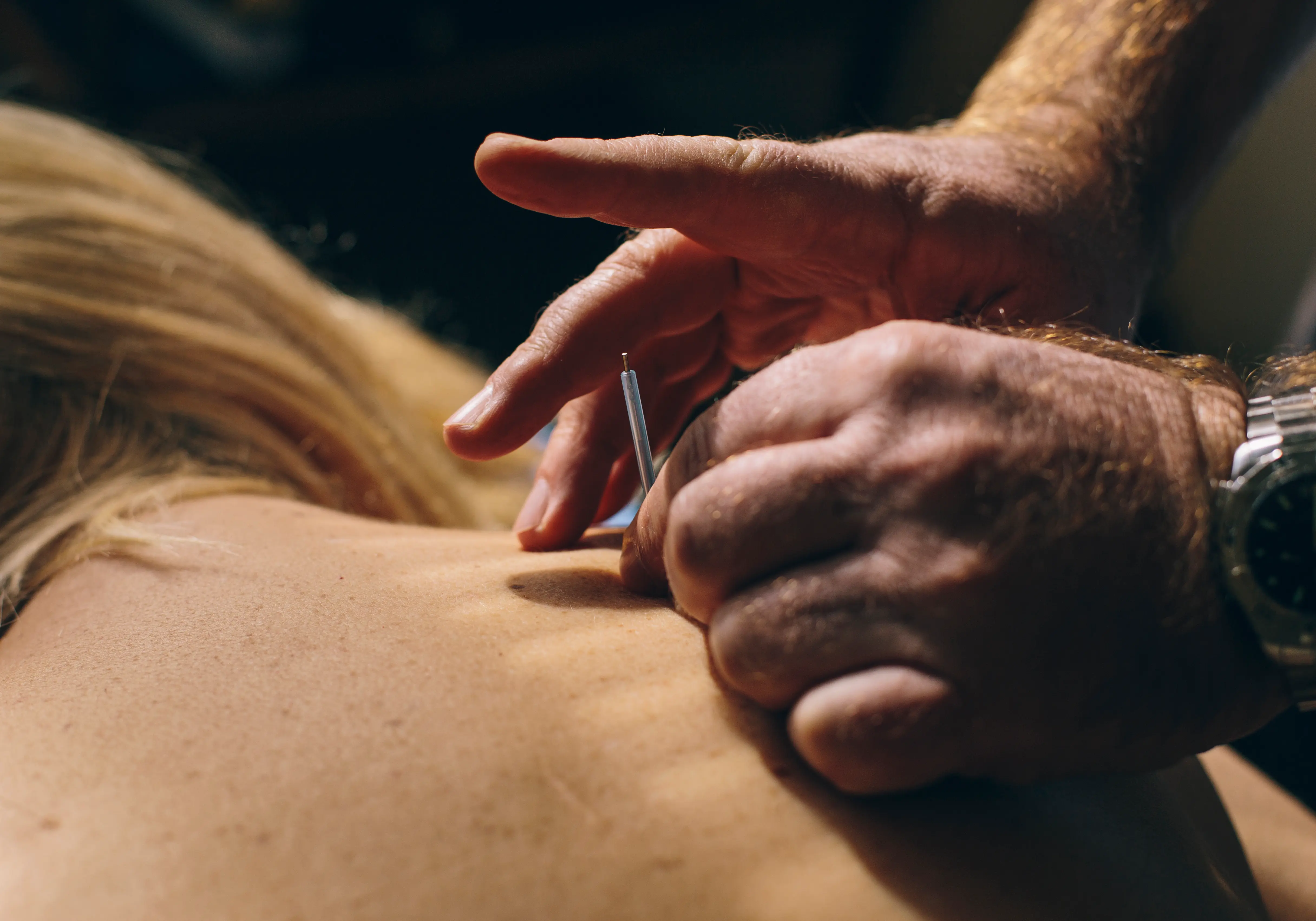
What acupuncture may offer is support with some of the symptoms that can make that recovery difficult — headaches, neck pain, muscular tension, poor sleep, stress, irritability and the feeling of being mentally overwhelmed.
In practice, that might mean looking at:
- post-concussion headaches
- neck pain and muscular tension
- poor or unrefreshing sleep
- feeling easily overwhelmed by noise, light or activity
- stress, irritability or low mood
- the brain fog and fatigue that can accompany a prolonged recovery
As with the rest of my work, the aim isn't to chase each symptom separately. It's to understand the whole picture.
What happened? Where does it hurt? How is your sleep? How has your energy changed? What makes the symptoms better or worse? How is your neck? And what is making everyday life difficult right now?
From there, treatment can be tailored to the person rather than simply to the diagnosis.
What the research says
Research into acupuncture for concussion is still developing, and the evidence base is much smaller than it is for conditions such as chronic pain or headache.
One interesting randomised controlled trial, published in Radiology in 2025, followed 66 people with mild traumatic brain injury. Participants were divided between real acupuncture, sham acupuncture and a waiting-list control group. The acupuncture group received 14 treatments over four weeks.
After treatment, the acupuncture group had a greater reduction in post-concussion symptoms than either control group. When the researchers followed participants six to twelve months later, the improvement in symptoms was still evident in the acupuncture group.
The researchers also used diffusion-tensor MRI to look at aspects of white-matter microstructure. They found an improvement in a measure called fractional anisotropy in part of the brain's white matter after acupuncture, and this change was associated with better symptom outcomes at the six-to-twelve-month follow-up. Importantly, however, the MRI scans were taken before treatment and after the four-week treatment period — not six to twelve months later.
It's an encouraging finding, but it is still one relatively small study. There were only 22 people in each of the three groups, the study was conducted at a single centre, and the researchers themselves note that larger and more diverse studies, with longer-term imaging, are needed.
So I wouldn't present this study as proof that acupuncture repairs an injured brain. What it does provide is an interesting piece of early evidence that acupuncture may help reduce post-concussion symptoms, and that there may be measurable changes in the brain associated with that improvement.
That is worth investigating further.
A gradual return matters too
Recovery from concussion isn't necessarily about lying still until every symptom disappears.
Your healthcare professional or concussion service can guide you through a gradual return to normal activities, including work, study, exercise and sport. The right pace is individual, and a significant or sustained increase in symptoms is a reason to adjust the load rather than simply push through.
Acupuncture can sit within that wider recovery process, rather than replacing it.
A gentle approach, tailored to you
No two concussions are the same, and no two recoveries are either.
Some people come to me relatively early, looking for support while they work through their recovery with their GP or concussion service. Others arrive further down the track, when most of the symptoms have settled but the headaches, poor sleep, neck tension or fog haven't quite let go.
Wherever you are in that process, treatment begins with listening — to what happened, how you've been since, and what's making daily life hardest right now.
From there, we work gently and gradually, tailoring treatment to you.
Recovery from concussion can test your patience. But for most people, the way back is there.
If you're recovering from a concussion and wondering whether acupuncture might help, you're welcome to get in touch to talk about your situation and whether treatment could be a useful part of your injury and pain care.
Reference
Wang Z-N, Ding J-R, Li X, et al. Acupuncture Improves MRI Brain Microstructure with Postconcussion Symptoms in Mild TBI: A Randomized Controlled Trial. Radiology. 2025;316(1):e250315. doi:10.1148/radiol.250315.





.svg)