Back pain is one of the most common reasons people come to see me.
By the time we meet, many people have already done exactly what I'd hope they would. They've seen their GP, osteopath or physiotherapist, they're trying to keep moving, and they've begun rehabilitation.
If symptoms are more severe, or aren't settling as expected, they may also have been referred to a sports physician or spinal specialist. Further investigations, such as an MRI, are often arranged as part of that process.
In New Zealand, however, those appointments and scans can sometimes involve a considerable wait. During that time people are often still living with pain, trying to work, care for their families and wondering exactly what's going on.
That's when many people come to see me—not because they're looking for an alternative to the care they're already receiving, but because they're looking for something that might help them keep moving forward while they wait, or because their recovery has reached a plateau.
An MRI is only one piece of the puzzle
When an MRI is eventually performed, it's common to see words like disc bulge, disc herniation or degeneration.
Those findings can sound alarming, and it's completely understandable that people focus on them.
The reality, however, is often more reassuring.
MRI scans are excellent at showing us the structure of the spine, but they don't always explain why someone is experiencing pain. Research has shown that many of the changes commonly seen on MRI are also found in people who have no back pain at all. Like wrinkles in the skin or grey hair, some changes are simply part of the normal ageing process.
That doesn't make MRI findings unimportant.
It simply means they need to be interpreted alongside your symptoms, your examination and how your back is behaving—not viewed in isolation.
Your body is designed to heal
One of the most encouraging things we know about back pain is that our bodies have an impressive capacity to recover.
Even when an MRI shows a disc herniation, research suggests that many improve naturally over time as the body gradually repairs and adapts.
That doesn't mean you should simply wait and hope for the best.
Healing is only one part of recovery.
For many people, the bigger challenge is regaining confidence in movement, rebuilding strength and returning to work, sport or everyday life.
Those things don't always happen automatically.
When should you seek urgent medical advice?
Whilst most episodes of back pain improve with time and appropriate care, there are situations where further investigation is important. You should seek prompt medical assessment if your back pain is associated with:
- Difficulty controlling your bladder or bowels, or numbness around the saddle (groin) area.
- Progressive weakness in one or both legs.
- Significant trauma, such as a fall from height or a major accident.
- Fever, unexplained weight loss, or feeling generally unwell alongside your back pain.
- A history of cancer together with new, persistent back pain.
- Pain that is severe, constant, and doesn't ease with rest, particularly if it is worsening rapidly.
Fortunately, these situations are uncommon.
For the vast majority of people, back pain is not caused by a serious underlying condition. The challenge is rarely that the spine is "broken"—it's understanding why it hurts, helping it recover, and getting you back to the things you enjoy.
Why does back pain sometimes linger?
Pain is much more than damaged tissue.
After an injury, muscles often tighten to protect the area. The nervous system can become more sensitive. Sleep may suffer. It's also completely understandable to become cautious about bending, lifting or exercising if you believe your back has been damaged.
Over time, those protective responses can begin to slow recovery.
One of the most valuable parts of treatment is helping people regain confidence in their back so they can begin moving more comfortably again.
Where acupuncture fits
People sometimes ask whether acupuncture can "fix" a bulging disc.
I don't think that's the right question.
By the time people come to see me, they're rarely looking for an alternative to physiotherapy or osteopathy. More often, they're looking for something that might help them move forward when progress has stalled.
Many already have a rehabilitation plan. Pain, however, is making it difficult to exercise comfortably, build strength or return to normal activities.
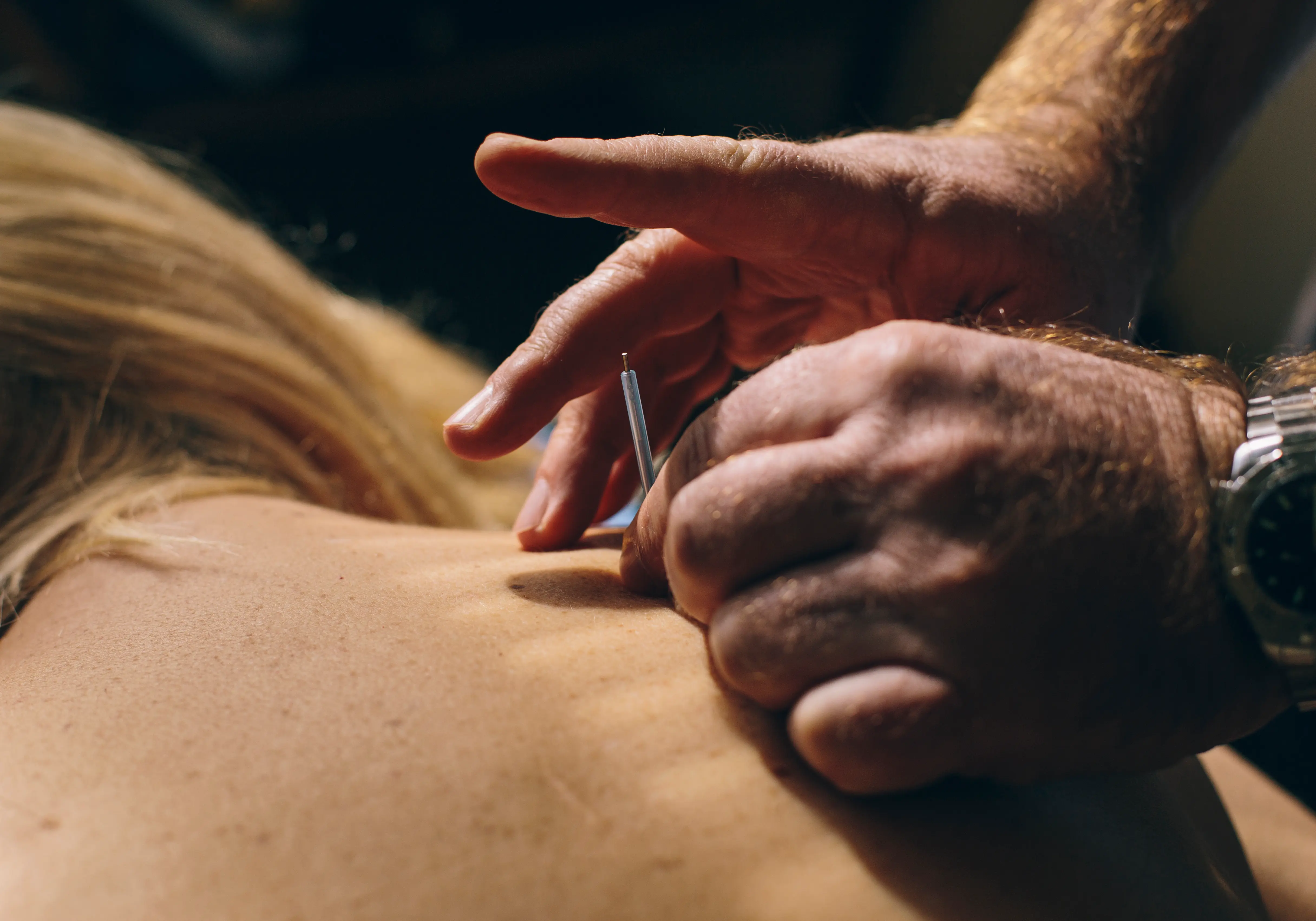
In these situations, acupuncture may help reduce pain, ease muscle tension and calm an overprotective nervous system. When pain becomes more manageable, rehabilitation often becomes easier too.
Recovery rarely depends on one treatment alone.
Good rehabilitation, appropriate movement, time, reassurance and, for many people, acupuncture can all play a part.
Acupuncture and dry needling
Patients sometimes ask whether acupuncture is simply another form of dry needling.
There is certainly some overlap. Both use fine needles, and in some situations the techniques can look quite similar.
The biggest difference isn't the needle itself.
It's the clinical reasoning behind its use.
Dry needling often focuses on treating painful muscles and trigger points, and it can be an effective treatment for many musculoskeletal conditions.
As a trained and experienced acupuncturist, my assessment is usually broader. Alongside the painful tissues, I'm interested in how your symptoms developed, what aggravates or eases them, how you're moving, what treatments you've already had and what might be slowing your recovery.
My treatments are informed by both acupuncture theory and a modern sports medicine approach. Sometimes that means treating painful muscles directly. Sometimes it means using electro-acupuncture. Often it means using the gentle Japanese acupuncture techniques that form the foundation of my practice.
The treatment is guided by the person in front of me—not by a single technique or a fixed recipe.
Good treatment isn't about using the same technique for everyone. It's about choosing the right stimulus, at the right time, for the right person.
Treat the person, not the picture
MRI scans are valuable.
They answer important questions.
But they rarely tell the whole story.
A diagnosis is the beginning of clinical reasoning—not the end of it.
The important questions become:
Why is this person still in pain?
What is limiting their recovery?
What treatment is most appropriate today?
Those answers are rarely found on an MRI report.
They come from listening carefully, examining thoroughly and understanding the individual sitting in front of you.
If you've recently had an MRI and you're worried by what it says, remember this:
Your scan is one chapter of your story.
It isn't the whole book.




.svg)